

LGMS - Online Lessons
 Admin
Admin- 2026-05-25 13:38:59
What are large language models (LLMs)?
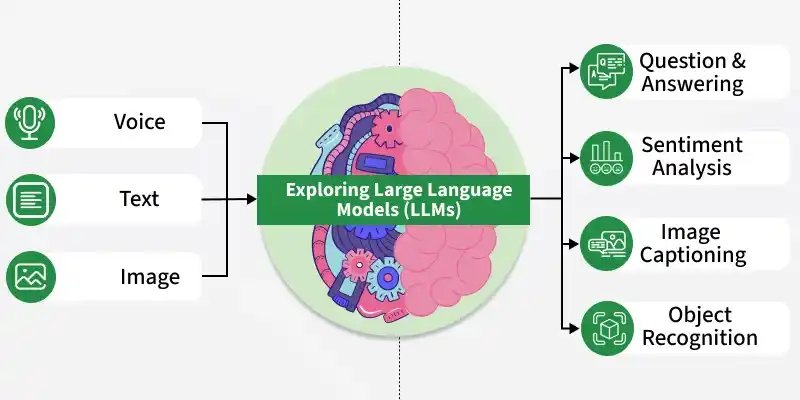
Large language models (LLMs) are a category of deep learning models trained on immense amounts of data, making them capable of understanding and generating natural language and other types of content to perform a wide range of tasks. LLMs are built on a type of neural network architecture called a transformer which excels at handling sequences of words and capturing patterns in text.
LLMs work as giant statistical prediction machines that repeatedly predict the next word in a sequence. They learn patterns in their text and generate language that follows those patterns.
LLMs represent a major leap in how humans interact with technology because they are the first AI system that can handle unstructured human language at scale, allowing for natural communication with machines. Where traditional search engines and and other programmed systems used algorithms to match keywords, LLMs capture deeper context, nuance and reasoning. LLMs, once trained, can adapt to many applications that involve interpreting text, like summarizing an article, debugging code or drafting a legal clause. When given agentic capabilities, LLMs can perform, with varying degrees of autonomy, various tasks that would otherwise be performed by humans.
LLMs are the culmination of decades of progress in natural language processing (NLP) and machine learning research, and their development is largely responsible for the explosion of artificial intelligence advancements across the late 2010s and 2020s. Popular LLMs have become household names, bringing generative AI to the forefront of the public interest. LLMs are also used widely in enterprises, with organizations investing heavily across numerous business functions and use cases.
LLMs are easily accessible to the public through interfaces like Anthropic’s Claude, Open AI’s ChatGPT, Microsoft’s Copilot, Meta’s Llama models, and Google’s Gemini assistant, along with its BERT and PaLM models. IBM maintains a Granite model series on watsonx.ai, which has become the generative AI backbone for other IBM products like watsonx Assistant and watsonx Orchestrate.
Self-attention:
The model passes the tokens through a transformer network. Transformer models, introduced in 2017, are useful due to their self-attention mechanism, which allows them to “pay attention to” different tokens at different moments. This technique is the centerpiece of the transformer and its prime innovation. Self-attention is useful in part because it allows the AI model to calculate the relationships and dependencies between tokens, especially ones that are distant from one another in the text. Transformer architectures also allow for parallelization, making the process much more efficient than previous methods. These qualities allowed LLMs to handle unprecedentedly large datasets.
-
Commentaires : 1
Students, Learners?
Partager l'article: